Dressing Up Profits: Amplifying Apparel Brand's Growth through Effective Email Marketing
- Social Thunder
- Sep 28, 2023
- 5 min read

In a span of 90 days, more than £90,000 was produced
KEY ACHIEVEMENTS
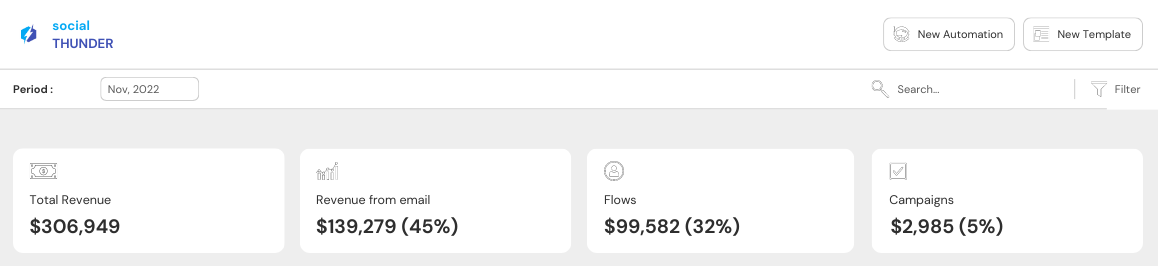
There was a 44% increase in revenue generated from email campaigns during the month of November.
A total of £99,582 was generated through email campaigns over a period of 90 days.
BRAND STORY & CHALLENGES
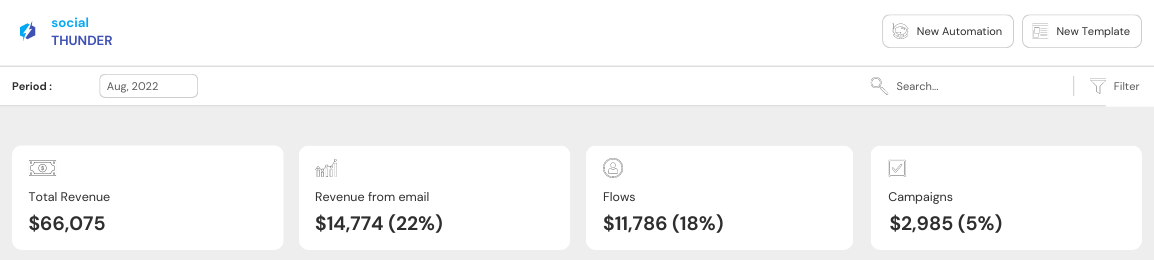
This case study highlights the brand story and challenges of a UK-based fashion e-commerce client specializing in athletic clothing. Despite having email flows set up with Klaviyo, their campaign emails were underperforming with low open rates and click-through rates, resulting in only 5% - 8% of their total store revenue.
Starting in late September, we collaborated with the client to implement a new email campaign strategy aimed at increasing revenue, engagement, trust, and customer retention. By October, we had achieved significant success, with email campaign revenue accounting for 44% of total store revenue in November.
It's worth noting that this case study exclusively focuses on campaign emails. If you're interested in learning more about email flows, check out some of our other email marketing case study examples. Additionally, for a comprehensive breakdown of the 5 fundamental email flows, please refer to our article on generating $540,000 from email marketing in one year.
BEFORE
The email campaigns were suffering from open rates that were less than 10%, and the campaign emails were only generating 5% - 8% of the total store revenue.
Furthermore, the focus of the campaign emails was limited to sales and promotions.
BEFORE WORKING WITH US
AFTER
The email campaigns achieved an open rate of over 20% on a consistent basis.
In November, the email campaigns accounted for 44% of the total store revenue.
This was made possible by implementing trust-building and content-focused campaign emails that proved to be highly effective in driving revenue.
90 DAYS WITH US
HOW WE HELPED
The effectiveness of campaign emails is a crucial factor in the success of e-commerce email marketing, as demonstrated by numerous case studies. Unlike triggered flow emails that are sent in response to specific customer actions, campaign emails are discretionary and fall into four main categories: Sales, Promos, Trust, and Content. Sales emails inform customers about sales events, while Promos highlight specific products. Trust emails emphasize social proof, such as customer reviews, while Content emails provide detailed information on topics relevant to the e-commerce store.
Our client had been using only Sales and Promo emails before they engaged our services. We identified this as a problem and addressed it. Here is an overview of our client's email campaign performance one month prior to our collaboration.
It is not recommended to excessively rely on sales and promo emails as customers are less likely to open your emails if they are not provided with diverse and engaging content.
Our client faced a major issue of low open rates, which can harm the sender's reputation and overall deliverability if below 20%. Prior to collaborating with us, their campaign emails were experiencing open rates of less than 10%.
To address this problem, we introduced Trust and Content emails into their campaign strategy as one of our initial steps.
Immediately, we were able to increase our client's email campaign revenue from 5% to 22% of their overall store revenue.
Our Trust and Content emails, which were in the form of blogs, achieved an impressive open rate of over 25%. This, in turn, had a positive effect on the open rates of our Promo emails.
It's worth noting that Trust and Content emails are primarily aimed at building a relationship with customers rather than generating immediate sales. However, we found that these emails consistently generated high revenue for our clients.
In fact, in some instances, the revenue generated by our Content emails surpassed that of our Promo emails. For example, in this particular email marketing campaign case study, Blog 10.16 generated more revenue than Promo 10.23.
SEGMENTATION
Improving customer engagement and open rates requires effective list segmentation. Prior to working with us, our client was either sending campaign emails to their entire email list or very small segments.
To address this issue, we developed a campaign strategy for October that segmented their email list based on engagement. To maintain open rates above 20%, we recommend segmenting your email list based on factors such as open rates, clicks, and previous purchases.
Segmenting your email list not only enhances deliverability and overall list health but also enables you to prepare your list before major sales events.
These are the promotional emails that we dispatched during November.
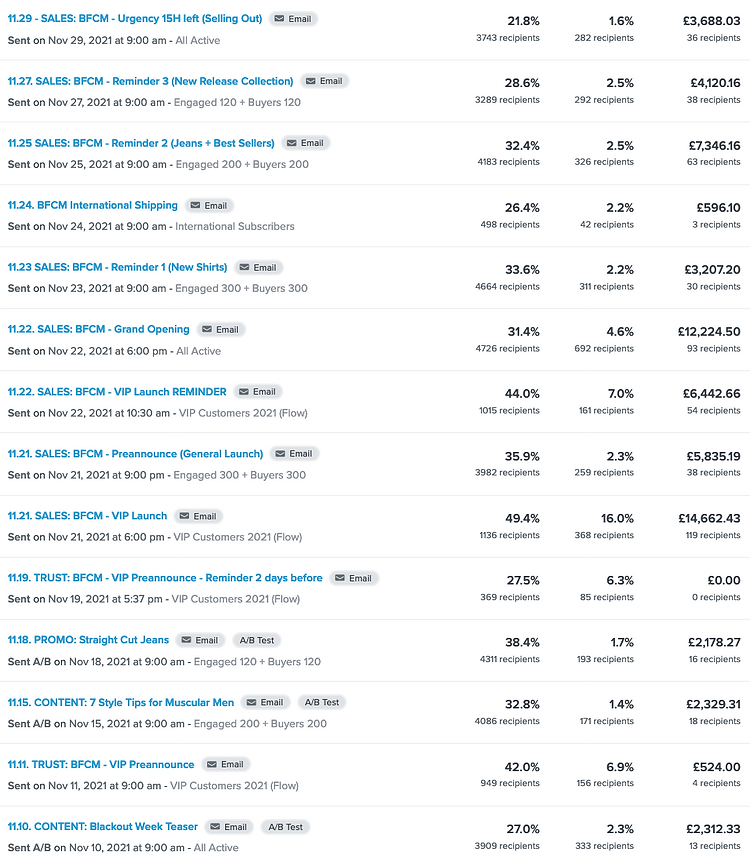
During the highly competitive BFCM period, what factors contributed to the success of our campaigns? Let's analyze the key elements.
1. START WITH A GOOD OFFER
Begin by ensuring that you have a compelling offer before sending out any BFCM emails. In this case, our client offered storewide discounts ranging from 30% to 50%. Additionally, VIP customers received an extra 10% discount on top of that. We will go into more detail on this later.
2. START EARLY
It's important to start your BFCM campaign early to build anticipation and engagement with your customers. Our client's campaign started with teaser emails on November 10th, and VIP customers received two pre-announcements before the general public. This allowed customers to plan ahead and get excited about the upcoming deals.
3. TAKE CARE OF YOUR VIP CUSTOMERS
Segmenting your email list and taking care of your VIP customers is just as crucial during BFCM as it is throughout the rest of the year. For this client, we classified customers who had purchased at least twice as VIPs and gave them an additional 10% discount on top of the already impressive discounts of 30%-50% storewide. VIPs were also granted early access to the sale and received two pre-announcement emails before everyone else. This strategy generated over £14,000 in revenue with a single email. It is essential to reward customer loyalty and make them feel valued. Providing exclusive deals to VIP customers can lead to high engagement and revenue.
4. SEND SEVERAL EMAILS
We implemented a strategy of sending out 14 emails in November, with 12 of them directly related to Black Friday. By using announcements, reminders, and urgent emails, we were able to effectively communicate with our client's customers. Additionally, we used BFCM as an opportunity to promote new product releases, which proved to be very successful. Outside of the Black Friday context, we typically send out 12 email campaigns per month. Before working with us, the client only sent out around 4-8 campaign emails per month, which was detrimental to their open rates and customer engagement. However, our consistent approach to email marketing has proven to be successful, as demonstrated by the revenue generated in the first 90 days of working together.
5. USE URGENCY AND SCARCITY
Incorporating scarcity into your urgency emails can further incentivize your customers to convert, especially if you have limited stock in the last few days of your sale.
CONCLUSION
In this email marketing case study, the significance of effective brand-customer communication for generating sales revenue and long-term growth is highlighted. To execute a successful campaign strategy, it is crucial to maintain consistency, strike a balance between Sales, Promo, Trust, and Content emails, and implement good segmentation practices. However, it is important to remember that customer retention should be a top priority, as your most loyal customers are the most valuable assets to your e-commerce business.


Comments